/filters:quality(70)/prod01/channel_46/media/schools-and-colleges/tourocop/images/pharmacy-mobile.png)
More Time in the Field Sets TCOP’s PharmD Curriculum Apart
TCOP Students Gain Expanded Hands-On Experience While Exploring a Wider Range of Pharmacy Careers
/filters:quality(70)/prod01/channel_46/media/touro-college/communications/images/featured/2026/BatoulSenhajiTomzawithstudentAlecChunilall.jpg)
At Touro College of Pharmacy (TCOP), the PharmD curriculum is designed around the idea that the best way to prepare future pharmacists is to give them meaningful experiences within real-world healthcare settings.
Most pharmacy schools follow a traditional model: three years of classroom instruction, followed by one year of experiential training. TCOP’s distinctive 2.5/1.5 curriculum shifts that balance. Students spend two and a half years in the classroom and a full year and a half completing rotations in the field, gaining hands-on experience across a wide range of pharmacy settings.
Experience is Key
Dr. Batoul Senhaji-Tomza, associate dean of curriculum and an associate professor in the Department of Social, Behavioral and Administrative Sciences, says the structure reflects TCOP’s strong emphasis on experiential learning: “Our program really values hands-on experience, and that’s why we are not a traditional pharmacy program.”
The rotations, known as Advanced Pharmacy Practice Experiences (APPEs), place students in healthcare settings under the supervision of practicing pharmacists. At TCOP, each APPE lasts six weeks, longer than the four-week rotations common at many programs.
Students complete core rotations required of all pharmacy schools, but TCOP’s structure also allows for three additional elective APPE rotations. “That really allows our students to get a taste of the various branches of pharmacy practice,” Dr. Senhaji-Tomza says. “They can experience clinical settings, community pharmacies, industry roles or public health environments.”
Oh, the Possibilities
For Alec Chunilall, a current TCOP student, the program has helped him see just how many directions a career in pharmacy can take. “There are so many more possibilities that we don’t know about at first,” he says. “Touro makes it their mission to expose us to different areas so you can make a wise decision once you graduate.”
Chunilall adds the program’s first two and a half years are academically demanding, but he appreciates completing most of the classroom work early so students can focus more on practical learning later in the program: “It’s a practical field. You need the background knowledge, but you also need that hands-on training to really understand what the job is like.”
Finding the Right Path
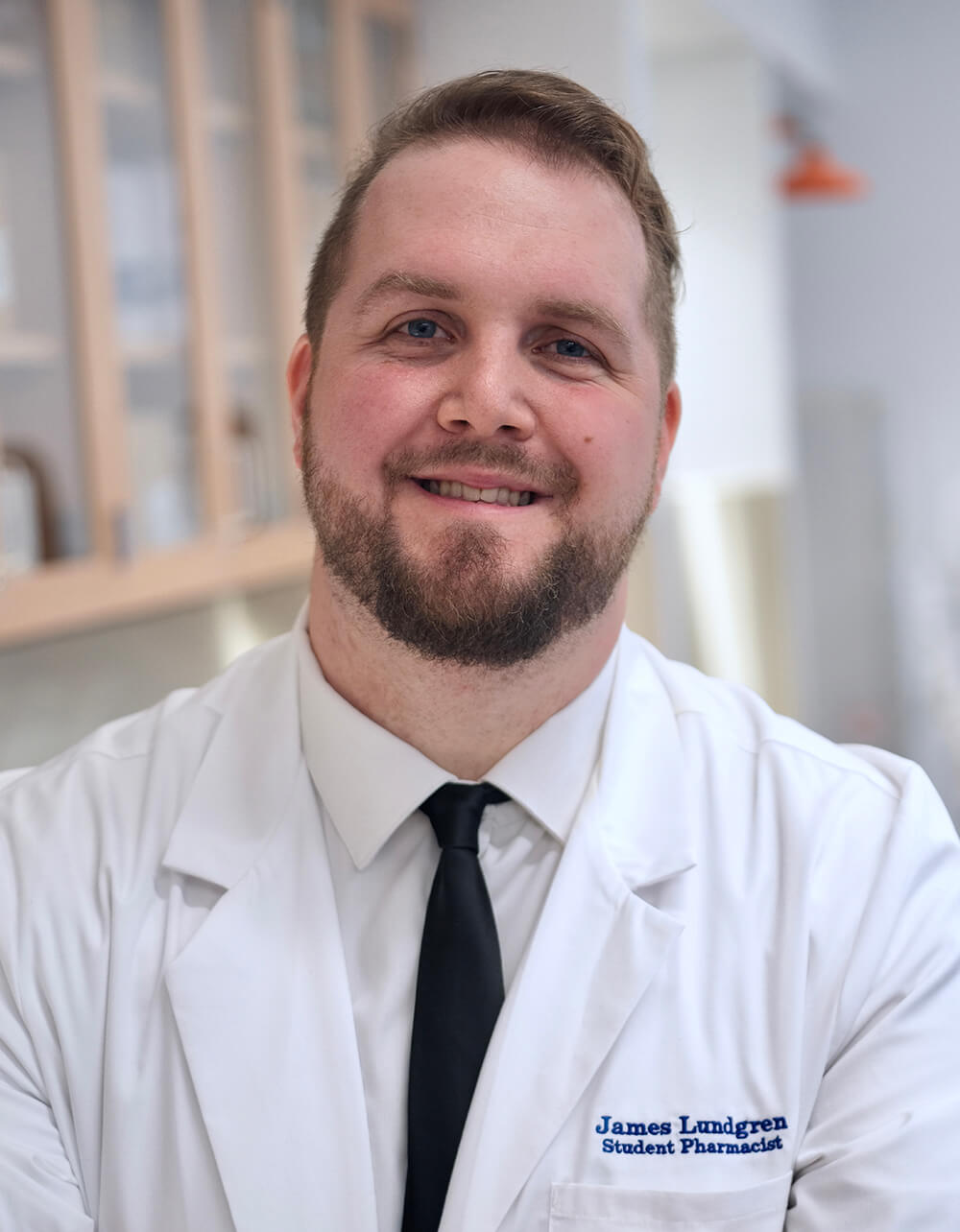
For TCOP graduate James Lundgren, who earned his PharmD in 2024, the extended rotations helped reshape his career.
When he enrolled, Lundgren expected he would remain in retail pharmacy, where he had worked as a pharmacy technician. But through his APPE rotations, he discovered new interests, and ultimately, one in ambulatory care at the STAR Health Center at SUNY Downstate Medical School in Brooklyn that changed his trajectory.
“This is the perfect mix of pharmacy that I love,” he shares. “There’s the clinical side, plus you get to actually deal with patients on a regular basis. So, I figured this is exactly where I wanted to go.”
Looking back, he says the combination of classroom instruction and extensive experiential learning helped him enter the profession ready to hit the ground running. “The classes prepare you clinically, and the rotations help you develop the professionalism you need,” he explains.
After graduating, Lundgren completed a residency at SUNY Downstate, and in July, he moved with his wife and daughter to Orlando, where he is in his second year of residency training in ambulatory care. “We uprooted our life for the pursuit of furthering my education and landing a better career,” he says. “It’s probably the best move I ever made.”
