/filters:quality(70)/prod01/channel_46/media/schools-and-colleges/tourocop/images/pharmacy-mobile.png)
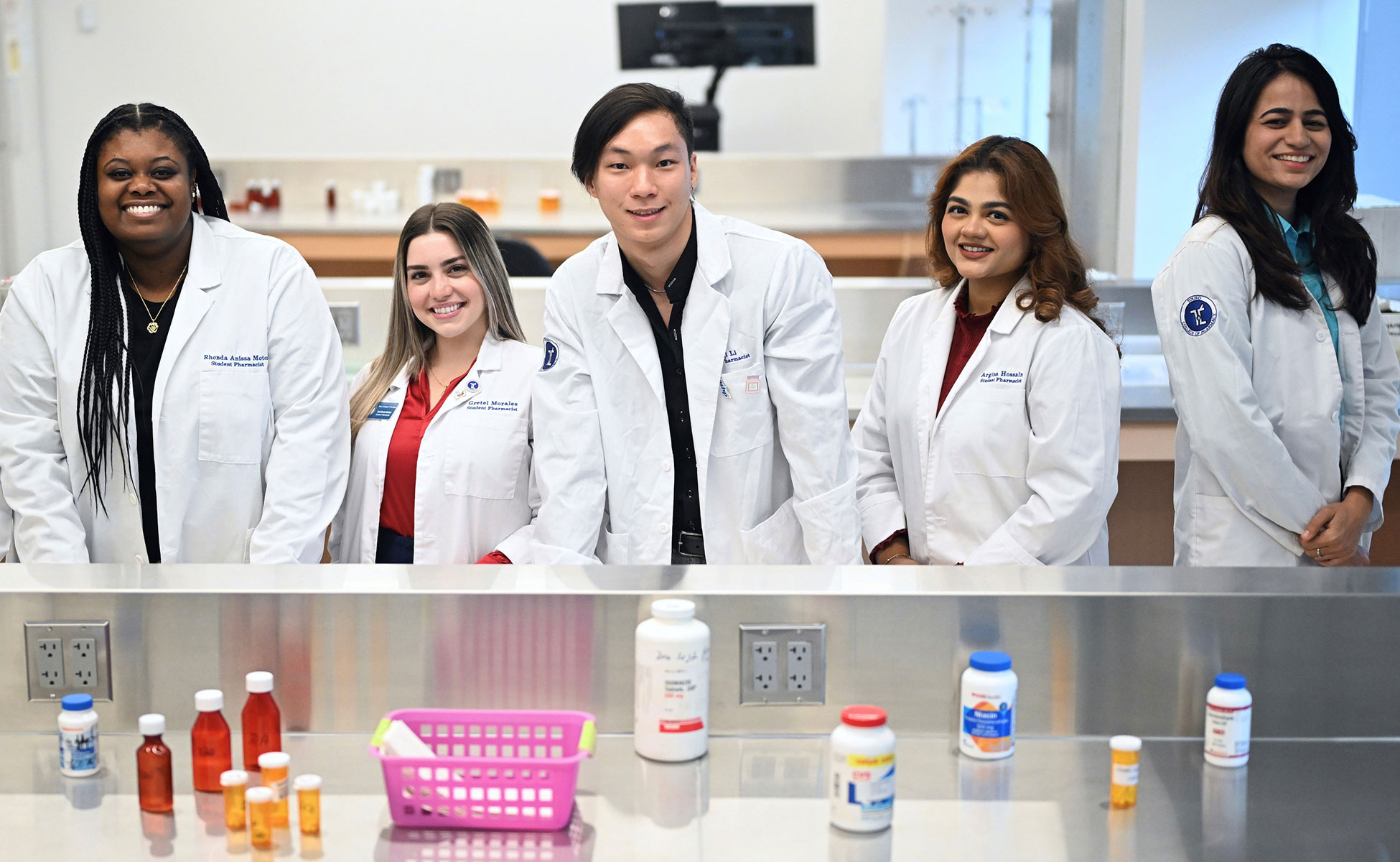
Our four-year PharmD curriculum emphasizes guided, individual learning through rigorous coursework and extensive practice experience. Experienced and engaged professors will mentor and advise you every step of the way, ensuring that by the time you graduate, you are as prepared as possible to embark on the next phase of your professional journey.
A Comprehensive Pharmacy Education, Tailored to Your Interests
Students spend the beginning of their pharmacy school career, the first 2.5 years, in the classroom, learning the ins and outs of pharmaceutical science, patient-centered care, evidence-based practice, and medication management. With a firm knowledge of pharmacy practice and pharmaceutical science, you'll head out to the field for the next 1.5 years, to complete practice experiences at our affiliate sites, learning first-hand about clinical practice, ambulatory care, general medicine, and institutional and community pharmacy practice.
A Strong Emphasis on Clinical Rotations
One of the highlights of our Doctor of Pharmacy program is our approach to learning. We think more opportunities to put into practice what you learn in the classroom will make you a better pharmacist. That's why we give you more time on rotations than most other colleges of pharmacy. You’ll have nine advanced practice experiences, totaling 54 weeks of hands-on, experiential learning.
You’ll start your clinical experience early – in the first year with an introductory experience in a community pharmacy, and the second year in a hospital setting. In your third and fourth years, you’ll have advanced pharmacy practice experiences. These experiences might be in a hospital, government agency, drug company, working in research, or in a number of different areas. A wide range of electives allows you to tailor your experience to specialized interests, from public health and research to oncology, psychiatry, and regulatory affairs.
What Sets Our PharmD Program Apart
Beyond more rotations, at TCOP you’ll have the opportunity to:
- Study in a first-rate facility. Our labs are equipped with professional compounding stations featuring digital balances, mortars and pestles, OHAUS Guardian 5000 hot-plate stirrers, and individual sink access. In our 1,400 sq. ft. Sterile Products Laboratory, students train using eight annually certified laminar-flow hoods, IV pump machines and a Baxa Repeater Pump, meeting current industry standards.
- Focus on a targeted career path. From research, to clinical pharmacy to the pharma industry, and more: Our tailored educational tracks put you on the fast-track to a successful pharmacy career.
- Enrich your knowledge beyond required coursework. Our co-curriculum and interprofessional education broaden your education to hone your professionalism and leadership, help you find your place in the pharmacy community, and understand what it means to be part of a healthcare team. You’ll participate in enriching activities outside of the traditional classroom experience, such as health fairs and community initiatives, and work with students in other healthcare fields such as osteopathic medicine, nursing and social work.
- Build strong relationships with your professors and peers. As a small school, we provide a unique opportunity to benefit immensely from the extensive real-world knowledge of your professors. Our tightknit, close community focus has a positive effect on your experience and learning outcomes.
All that means you’ll be fully prepared to start your career in pharmacy when you graduate. It’s no surprise that we have the highest NAPLEX pass rate in New York City. And best of all, our PharmD graduates have a 99% employment rate after graduation. With our affordable tuition and strong track record, you’ll be ready to make a difference, whether you choose to work here in the community or beyond.
After Graduation: Your Pharmacy Career
Upon completing the program, you will be prepared to take all three parts of the New York State pharmacist licensing exam. While many of our graduates become pharmacists in the community or hospital setting, others opt to pursue careers in academia, the pharmaceutical industry, or clinical research. Many of our PharmD graduates work in top hospitals and healthcare centers such as Memorial Sloan Kettering Cancer Center, New York-Presbyterian Hospital, and Mount Sinai Hospital. 23% of our graduates go on to residencies in the New York area and beyond.
Whatever your ambitions, our PharmD program will help you develop the broad knowledge, practical skills, and professional network to effectively serve patients, families, and communities.
PharmD Salary
As the career path you choose after graduation can vary, salaries in the field have a large range. Pharmacists working in a hospital setting tend to make more, with a median annual salary of around $150k, while pharmacists working in a pharmacy have a median annual salary of around $130k (BLS.gov). A Pharmacy Director can make upwards of $240k (Salary.com).
The Demand for PharmD Graduates
Currently, PharmD graduates are needed now more than ever. With an aging population and a shortage of skilled labor in the field, pharmacists are in high demand. Clinical and hospital settings will see the most industry growth, and PharmD graduates will be sought after to take on new challenges in the field. The overall trend for pharmacy job growth is 5%, the same as the national average. Even with advances in automation, such as with AI, the pharmacy industry is poised for a stable job outlook.
